Euclid finds the most distant quasar yet, 630 million years after the Big Bang, while a tiny lensing blip hints at a black hole from the first second

Two new results about black holes in the early universe were released within days of each other. One is a confirmed measurement. The other is an intriguing single event that its own authors say they cannot yet explain.
The most distant quasar yet
A team using the European Space Agency's Euclid telescope has found the most distant quasar on record. A quasar is the brilliant core of a galaxy, powered by a supermassive black hole pulling in gas. The paper, by Julien Wolf and nearly 200 co-authors from the Euclid Consortium, was published Nov. 24 in Astronomy & Astrophysics. It is open access.
The quasar, formally EUCL J150452.291+625224.39, has a redshift of 8.129. That means the light now reaching us left it about 630 million years after the Big Bang. The team nicknamed it Dún Aonghasa, after a prehistoric stone fort on Ireland's Aran Islands. It is the first quasar confirmed beyond redshift 8. The previous record, also found in Euclid data and reported earlier this year, was at redshift 7.77, about 660 million years after the Big Bang. The new find moves the frontier back by about 39 million years.
Euclid's main job is mapping dark matter and dark energy. The object turned up as a candidate in 3,644 square degrees of the telescope's wide survey. It was confirmed in steps:
- an initial spectrum from the Keck Observatory in Hawaii in January;
- follow-up with the Hubble Space Telescope and the Large Binocular Telescope in Arizona;
- a spectrum from the James Webb Space Telescope that pinned down the redshift.
The authors estimate the black hole at about 360 million times the mass of the sun. That is a single-epoch estimate, based on the width of hydrogen and magnesium emission lines in one spectrum. Using different calibrations gives a range of roughly 210 million to 780 million solar masses.
What stands out is how slowly the black hole is feeding now. Its Eddington ratio, a measure of how fast a black hole is feeding compared with its theoretical maximum, is between 0.12 and 0.44. In other words, it is growing at well below its limit. Yet it already had hundreds of millions of solar masses only 630 million years into cosmic history. The authors write that this "requires either a massive seed or sustained, highly efficient early growth." Black holes that start from the remains of the first stars, about 100 times the mass of the sun, would have needed nearly uninterrupted maximum-rate feeding to get there in time.
This is not the kind of object ThinkPol reported on Wednesday, the "little red dot" CW-LRD-z10 seen about 450 million years after the Big Bang. Dún Aonghasa shows the textbook features of a quasar: a bright blue continuum of light and broad emission lines. The paper's comparison chart includes CW-LRD-z10 and places the new quasar well above little red dots in ultraviolet brightness at similar distances. The authors suggest that the quasars found so far in this era may be only the fastest-feeding members of a larger population of black holes that were already massive.
"Phoebe": a black hole from the first second?
The second result is much less certain. It is a preprint, a paper that has not yet been peer reviewed. Astronomers led by Renee Key at Swinburne University of Technology in Melbourne posted it in May and have submitted it to Monthly Notices of the Royal Astronomical Society. Press coverage over the past week has revived interest in it.
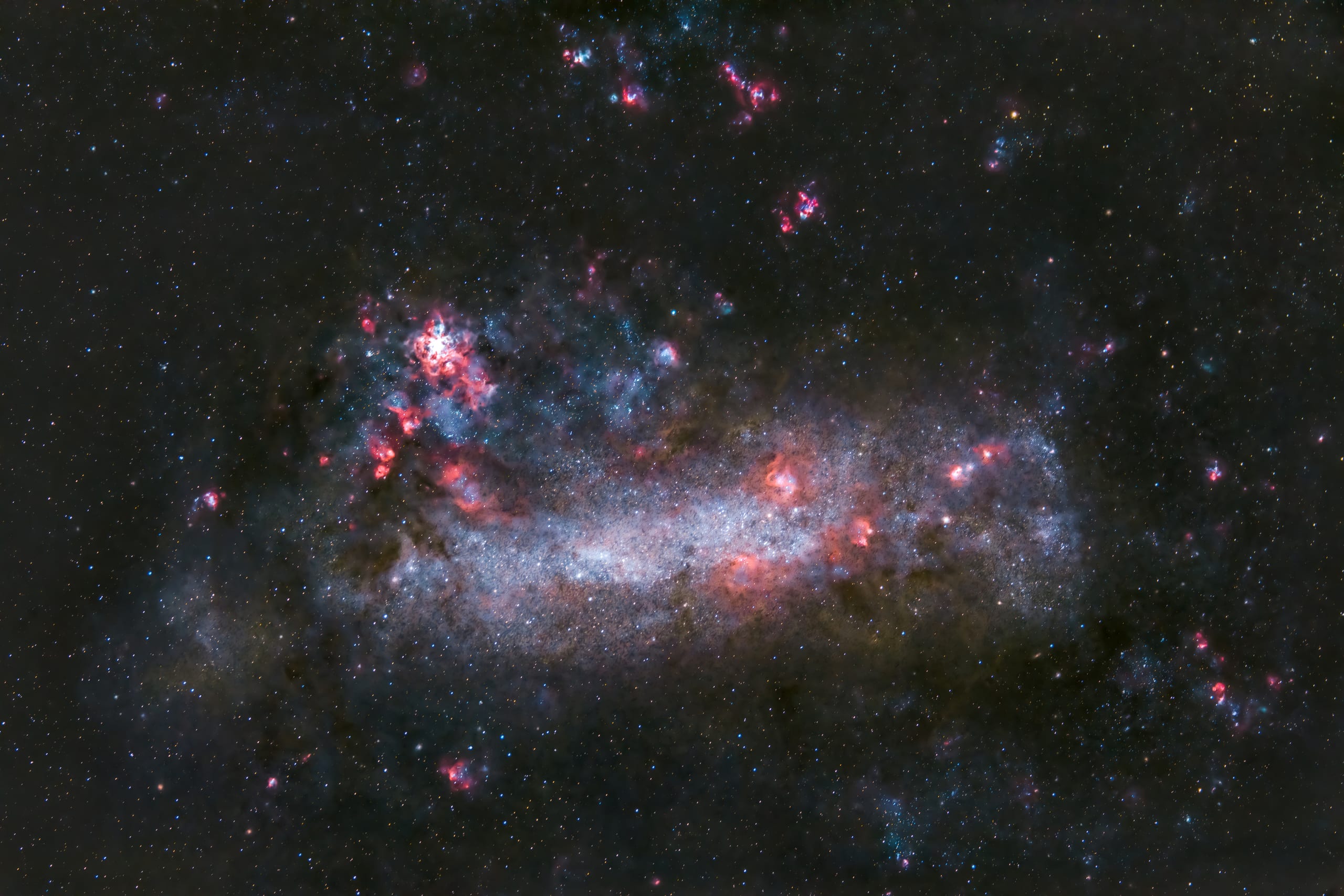
Over five nights in December 2019, the team watched the Large Magellanic Cloud, a small galaxy next to the Milky Way, with the Dark Energy Camera on a telescope in Chile. On Dec. 18, one star brightened smoothly and symmetrically for about an hour, then returned to normal. The authors interpret this as gravitational microlensing. In microlensing, an unseen object passes in front of a star and its gravity briefly magnifies the star's light. The team ruled out other causes they tested, including atmospheric blurring, nearby stars and flares.
Very brief microlensing events point to very light objects. The best-fit mass of the lens, which the team named Phoebe, is about 0.03 Earth masses, or roughly three times the mass of the moon. The uncertainty is wide: from about half a lunar mass to about 20 lunar masses, by ThinkPol's conversion of the paper's figures. Black holes made by collapsing stars are at least several times the mass of the sun. A black hole this small could only be "primordial," formed from dense pockets in the first moments after the Big Bang. Primordial black holes have long been proposed as a possible component of dark matter.
The authors consider three explanations:
- a free-floating planet in the Milky Way;
- a free-floating planet in the Large Magellanic Cloud;
- a primordial black hole in the dark matter halo that surrounds the Milky Way.
Their probability calculation favours the dark matter halo by more than five orders of magnitude. The paper notes that this result "is purely due to the higher intervening dark matter density along our line-of-sight." In plain terms, there is more dark matter than stars in that direction. A planet would be likely to be part of the stellar population. The authors also acknowledge that Phoebe's measured properties fall within the range expected for objects in the Large Magellanic Cloud.
"We cannot state the true nature of Phoebe," the paper says. With just one event, they cannot work out what population it belongs to. They write that the only way to tell primordial black holes apart from small free-floating planets is to find many more short events in many directions across the sky.
Sources: J. Wolf, S. Belladitta et al. (Euclid Consortium), "Euclid: Discovery of a quasar at z = 8.13 hosting a 360-million-solar-mass black hole," Astronomy & Astrophysics 715, A356, Nov. 24, 2026, DOI 10.1051/0004-6361/202662243; Renee Key, Edward N. Taylor, Ken C. Freeman, Jeremy Mould, Abhijit Saha, Anais Möller, Timothy M. C. Abbott and Alan R. Duffy, "AMPM II. A Lunar-Mass Primordial Black Hole Microlensing Candidate in the Milky Way Halo," arXiv:2605.19375, submitted to MNRAS, May 19, 2026.