Euclid, a telescope built to map distant galaxies, finds its first new comet passing high over the solar system

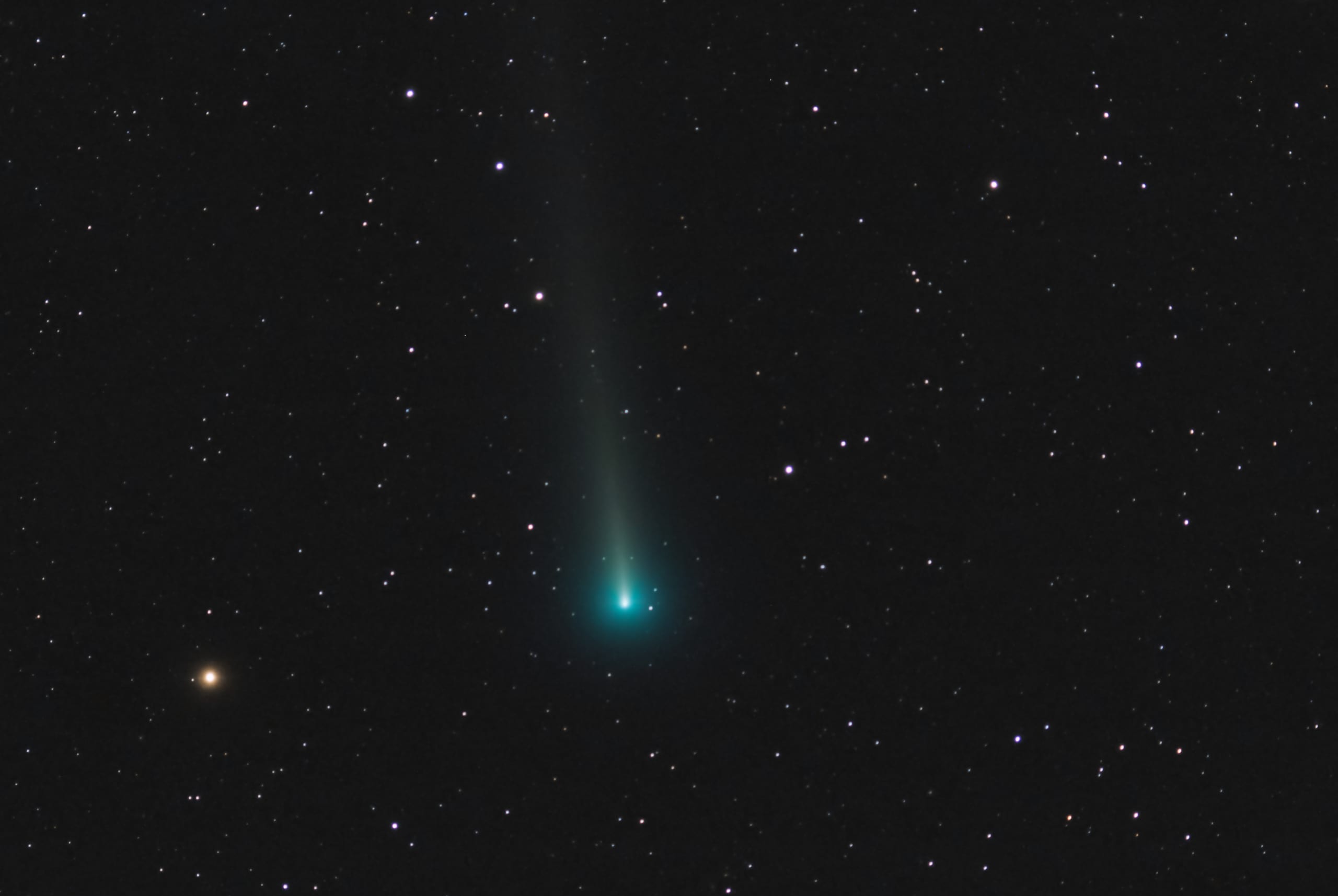
The European Space Agency's Euclid space telescope was built to map billions of distant galaxies, not to hunt for objects in our own solar system. It has found a new comet anyway.
The comet, now officially named C/2026 S1 (Euclid), is the first previously unknown comet discovered by the mission, ESA announced this week. It is about 1.3 billion kilometres from Earth, roughly between the orbits of Jupiter and Saturn.
A streak in the deep field
Mikko Pöntinen, a PhD student at the University of Helsinki who works with the Euclid Consortium's solar system objects group, wrote software to pick out small moving bodies in Euclid's images. Between Sept. 16 and 24, it flagged a streak, a sign of something moving fast across the frame, in a patch of sky called the Euclid Deep Field North.
"I was excited to see my software flag a 'streak' smeared across several images," Pöntinen said in ESA's announcement. He found the object in five sets of images, 16 exposures in all, and noticed a fuzzy cloud around it, the sign of a comet giving off dust and gas.
No known asteroid or comet matched, so he reported it to the International Astronomical Union's Minor Planet Center, which collects observations of small bodies and assigns their names. Telescopes on the ground followed up, and the centre confirmed the discovery on Oct. 8.
Passing over the top of the solar system
The comet is not travelling in the flat plane where the planets orbit. It is almost directly "above" the Sun and following a long, looping path that ESA says will take thousands of years to complete.
NASA's Jet Propulsion Laboratory has a preliminary orbit based on 63 observations over 56 days. It puts the orbit at about 85 degrees to the plane of the planets, and has the comet making its closest approach to the Sun around September 2027. Even then it will be about 8.7 times as far from the Sun as Earth is, a little inside Saturn's orbit. That means it will stay far too faint to see without a large telescope. With so short a record, the exact length of its orbit is still uncertain.
Why Euclid rarely finds comets
Euclid deliberately avoids the band of sky along the plane of the solar system, where most asteroids and comets are, because dust there adds stray light that would spoil its measurements of faint galaxies. It also images most patches of sky only once, so it can't easily go back for a second look at something new.
"Very few comets are expected to be discovered by Euclid, so it was a happy coincidence that the combination of the comet's orbit and Euclid's scanning over those days captured the object in multiple images," said Bruno Altieri, the mission's archive scientist.
ESA says the quick discovery and alert also served as a practice run for Comet Interceptor, a planned mission that will wait in space for a suitable newly discovered comet to visit. This comet is not a suitable target, but the agency says the exercise showed how the two missions could work together.
Euclid launched in 2023 to study dark matter and dark energy by measuring the shapes and positions of billions of galaxies up to 10 billion light-years away.
Sources: European Space Agency, announcement of the discovery of comet C/2026 S1 (Euclid), November 2026; IAU Minor Planet Center; NASA Jet Propulsion Laboratory Small-Body Database, C/2026 S1 (Euclid), orbit solution as of Nov. 25, 2026.