Ground-striking lightning could become 80 to 200 per cent more common in Canada by 2100 under high emissions, study projects

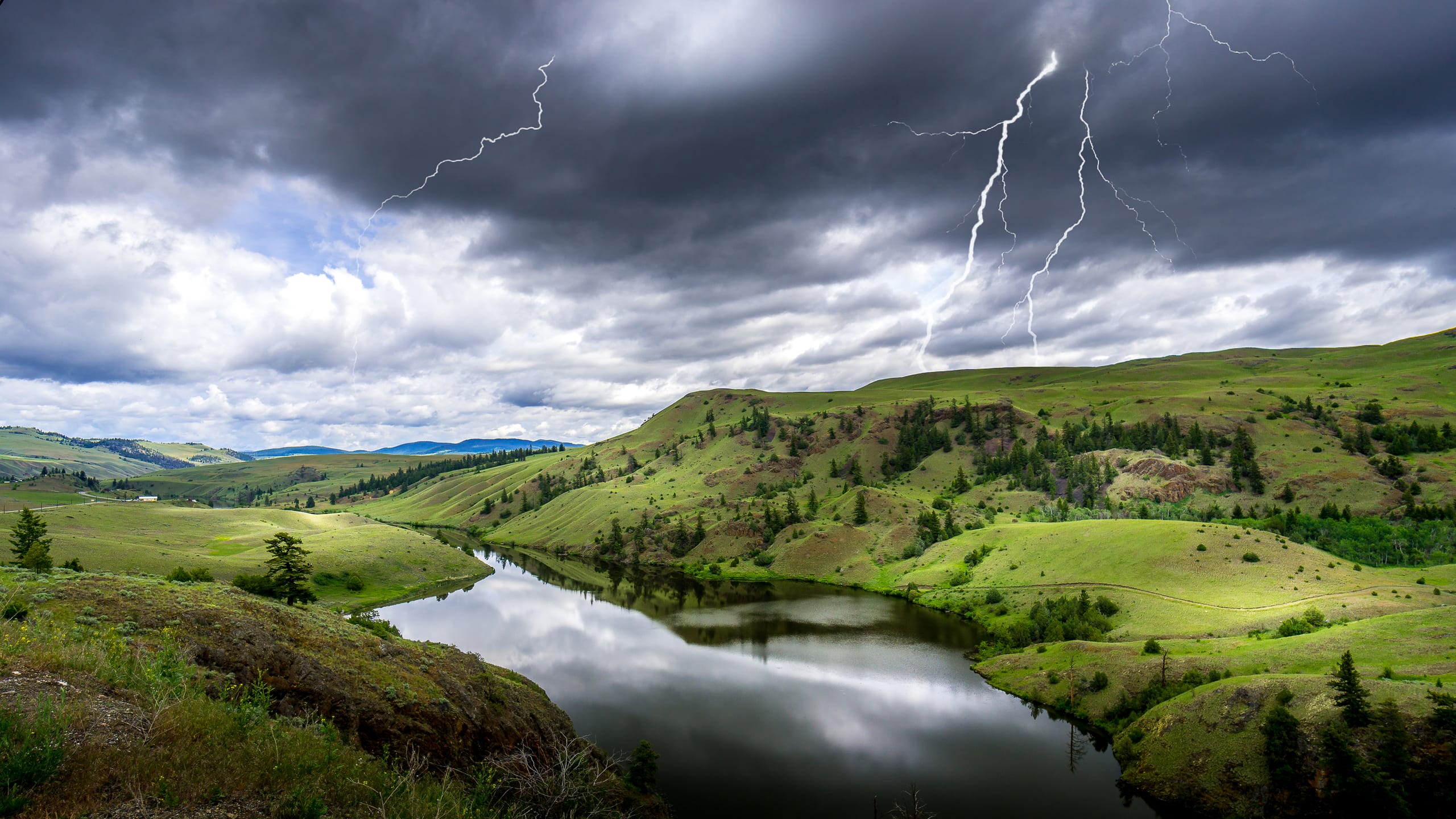
Lightning that reaches the ground could strike Canada 80 to 203 per cent more often by the end of the century if greenhouse gas emissions stay high, according to a new global projection. In British Columbia, lightning already starts most wildfires.
The study, published Nov. 24 in the American Geophysical Union journal Earth's Future, projects that cloud-to-ground lightning over the world's land will increase by 76 to 140 per cent by 2081–2100, compared with 1995–2014. The largest relative increases are at high latitudes, where lightning is now rare.
"I was quite surprised that the projections were so high," lead author Andreas Krause, an Earth system scientist at the Technical University of Munich, said in a release from the AGU. "I expected smaller changes."
Why ground strikes matter
Most lightning stays inside or between clouds. The fraction that reaches the ground is what starts fires, kills people and livestock, and damages power lines and other infrastructure. The authors cite estimates that lightning kills several thousand people a year and 301 to 340 million trees.
Most earlier work projected total lightning, often from satellite records that cannot tell cloud flashes from ground strikes. This team trained a machine-learning model (a method called XGBoost) on ground-based sensor networks that record only cloud-to-ground strikes. They used a data product built from Vaisala's Global Lightning Dataset (GLD360) and the U.S. National Lightning Detection Network, and tested the results against a second network run by Earth Networks.
The model predicts lightning density from six ordinary weather variables: temperature, precipitation, sunlight, humidity, air pressure and wind speed. Because climate models produce all six, it can be applied to any climate projection.
What the model projects
Run on historical weather, the model shows a modest rise of 11 per cent in ground strikes over the 20th century, or about 12 per cent per degree of warming. For the future, the researchers used two climate models chosen because they warm the least and the most among the five main models in the international ISIMIP project. Both runs used SSP3-7.0, a high-emissions scenario in which countries do not adopt new climate policies.
Under those conditions, the sensitivity more than doubles to roughly 30 per cent more ground strikes per degree of global warming. Previous estimates have mostly ranged from 0 to 17 per cent per degree.
Regionally, the study projects:
- Canada: 80 to 203 per cent more cloud-to-ground lightning
- Alaska: 116 to 594 per cent
- The Arctic north of 55° N: 81 to 245 per cent
- The contiguous United States: 55 to 129 per cent
- Germany: 32 to 83 per cent
The biggest increases in the number of strikes would be in the tropics, especially the Amazon and Southeast Asia. Percentage increases are largest in northern regions, where lightning density "often more than doubles." Canada already stood out in the model's historical run: it was one of the regions, along with Russia and Europe, with the largest relative increases over the 20th century.
Those northern results are in line with or higher than earlier regional studies. One earlier projection found a 24 per cent increase in northeastern Canada by mid-century, and another found a 112 per cent increase north of 55° N by 2100.
Why it matters in B.C.
The study does not model fires. But in B.C., lightning causes most of them. According to the B.C. Wildfire Service, an average of 60 per cent of the province's wildfires over the 10 years from 2014 to 2024 were started by lightning. In the record 2023 season, lightning caused 1,638 of the 2,293 fires, or 71 per cent, and 70 per cent of 1,697 fires the following year.
More strikes do not translate directly into more fires: whether a strike ignites depends on fuel moisture, rain falling with the storm and the time of year. The authors note that their model captures seasonal patterns well, which they say matters for predicting wildfire ignitions. Using the projections to estimate tree deaths from lightning and fire is among the follow-up work they propose.
Caveats
The authors list several limits. The main lightning data set overlaps with their climate data for only one year, 2019, and neither network publishes its detection efficiency, so regional blind spots could bias the results. The model uses only surface weather, not factors such as airborne particles or cloud ice that also affect lightning. Machine-learning models are also unreliable when conditions move far beyond anything in their training data.
That last problem is worst in the tropics. In the Amazon and New Guinea, future climate in the hotter model has no close match in today's weather. Some other studies project less tropical lightning in the future, not more. The paper's uncertainty analysis flags mainly tropical regions, not Canada. But the projections depend on emissions: the study models only a high-emissions future, and lower emissions would mean less warming and smaller increases.
The researchers have published their lightning projections on Figshare for others to use.
Source: Krause, A., Gregor, K., Qu, Y., Veraverbeke, S., and Rammig, A., "Large Projected Increase in Cloud-to-Ground Lightning Under Future Climate," Earth's Future (2026), doi:10.1029/2026EF008820 (open access, CC BY 4.0); American Geophysical Union release via Phys.org, Nov. 24, 2026; B.C. Wildfire Service, "Wildfire Averages" (updated Feb. 3, 2026).