Robot-assisted knee replacements cost more and did no better for patients in the largest blinded trial yet, echoing B.C.'s own review

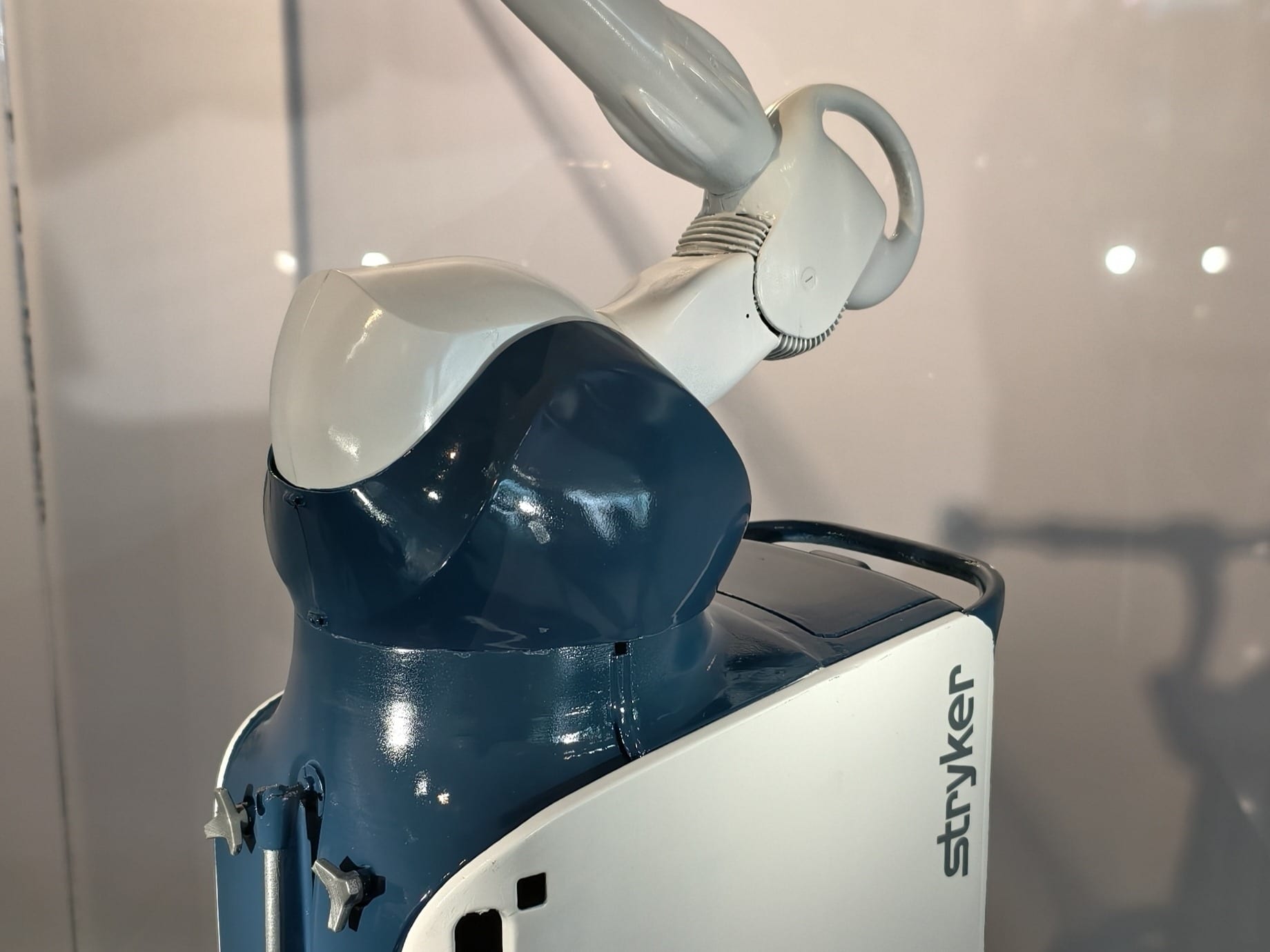
Patients whose knee replacements were done with the help of a surgical robot recovered no better after a year than patients whose surgeons used standard instruments, and the robotic operations cost more, according to the largest blinded randomized trial of the technology.
The trial, called RACER-Knee, compared conventional total knee replacement with surgery using Stryker's Mako robotic-arm system, the most widely used robot for joint replacement. Its results were published in The Lancet. The same system has been in use at Burnaby Hospital since 2024.
The trial
Researchers at 10 hospitals in England, Scotland and Wales randomly assigned 339 patients with advanced knee osteoarthritis to one of the two operations between December 2021 and December 2023. Thirty-three surgeons took part. The median patient age was 68.8 years.
Both groups received the same Triathlon implants, made by Stryker, and both had a CT scan and a computer surgical plan before the operation, so that only the robot's role in the operating room differed. Patients were not told which surgery they had received. The team used sham incisions, extra draping and masked operation notes to keep both patients and the people measuring their recovery from knowing.
The main measure was the Forgotten Joint Score, a 0-to-100 questionnaire on how often patients are aware of their artificial knee in daily life. The researchers had decided in advance that a difference of 12 points would count as a meaningful benefit.
What they found
- At 12 months, the average score was 49.2 in the robotic group and 50.2 in the conventional group. After adjustment, the difference was 1.5 points in favour of conventional surgery, which was not statistically significant. The range of plausible differences ruled out the 12-point benefit the trial was designed to detect.
- Pain in the first three days, opioid use, time to discharge, knee function scores, quality of life and pain at three, six and 12 months were all similar between the groups.
- The robot did make the surgery more precise. Leg alignment was on average 0.8 degrees closer to the surgeon's plan. But robotic operations took 10.5 minutes longer on average.
- Sixteen patients in each group had one serious adverse event. There were three deep infections in the robotic group and one in the conventional group, a difference the authors say could be due to chance.
The researchers also checked whether patients had guessed their operation. Of the 157 who thought they knew, 92 per cent believed they had the robotic surgery. Patients who believed they had the robot reported better scores, which the authors suggest may reflect people crediting the technology for a good outcome.
Cost
The initial hospital stay cost about £995 more per patient with the robot, mainly because of the robotic system's rental, maintenance and disposable costs. The researchers used figures supplied by Stryker, which assumed a five-year lifespan for the machine and 300 knee replacements a year. Over 12 months, robotic surgery cost about £958 more per patient and produced no gain in quality of life. The authors estimated a 4 per cent chance that it would be considered cost-effective under the thresholds Britain uses to decide what the National Health Service pays for.
"In this pragmatic trial, rTKR as delivered in routine practice was more costly than cTKR and did not provide a clinically meaningful patient benefit at 12 months," the authors wrote, referring to robotic and conventional total knee replacement.
The trial was funded by Britain's National Institute for Health and Care Research. Stryker supplied consumables, surgical instruments, the CT scans, 15 minutes of operating-room time per case, robotic systems at two of the hospitals and surgeon training. Several authors report research funding or consulting payments from Stryker and other implant makers. The authors say the trial team's independence was protected by contract.
What the trial does not settle
The trial reports outcomes up to one year. Follow-up is planned for 10 years to track revision surgery and longer-term recovery. The results apply to the Mako system only, and the authors say other robots need their own trials. Surgeons were free to use their usual alignment approach, so the trial does not test whether a personalized alignment strategy that only a robot can deliver would help.
"These results are by no means a condemnation of the robotic systems, but more understanding of the ideal position for a knee replacement and personalization for each patient is needed," co-lead investigator Edward Davis, an orthopaedic surgeon at the Royal Orthopaedic Hospital in Birmingham, said in a news release.
The use of robots varies widely. In 2024, robotic assistance was used in 6 per cent of knee replacements in the U.K., 16 per cent in the U.S. and 41 per cent in Australia, according to the paper.
A separate Canadian study raises a safety question. Researchers led by Sunnybrook Health Sciences Centre examined about 74,000 total knee replacements in Ontario from 2019 to 2023, of which 1,613 were robot-assisted. Within a year, 2.0 per cent of robotic patients had a major complication needing revision or further surgery, compared with 1.0 per cent of matched conventional patients. The study, published in The Journal of Arthroplasty, was observational, so it shows an association rather than proof that the robot caused the difference.
B.C.'s robot
In B.C., the province's Health Technology Assessment Committee reviewed robot-assisted knee replacement after a 2023 report prepared for the Ministry of Health by researchers at the University of British Columbia and the Vancouver Coastal Health Research Institute. The report noted that knee-surgery robots were "not currently in use in BC."
The committee found that the technology "does not demonstrate a significant clinical advantage over conventional knee arthroplasty," though limited evidence suggests it may improve implant alignment. It said robots would be expected to "significantly increase costs." It also noted that some surgeons strongly prefer robotic systems, which may affect recruitment and retention. It recommended a co-ordinated provincial plan if health authorities consider buying one, and left the decision to each health authority. The committee's findings page was last updated in January 2026.
Fraser Health went ahead before then. In April 2024, it announced a $2.3-million Mako system for the Jim Pattison Surgery Centre at Burnaby Hospital, fully paid for by the Burnaby Hospital Foundation and its donors. Robotic knee surgeries began on June 3, 2024. In November 2024, Fraser Health said its target was 350 Mako cases a year, about half of the hospital's hip and knee replacements. By May 2025, more than 100 patients had received robot-assisted knee replacements there, and the hospital had done B.C.'s first robot-assisted hip replacement.
In that May 2025 release, Burnaby Hospital's head of orthopedics, Dr. Tim Kostamo, said, "Post-surgery, patients report a better range of motion and less pain with this system compared to traditional joint-replacement surgery." In the British trial, where patients did not know which operation they had, pain and function scores were similar in both groups. Fraser Health said in 2024 that a quality-improvement review of its robotic cases was underway. ThinkPol did not find published results from that review.
Sources: Helen Parsons, Andrew Metcalfe et al., "Robotic-arm-assisted versus conventional total knee replacement (RACER-Knee): a pragmatic, multicentre, participant-masked and assessor-masked, superiority, randomised controlled trial," The Lancet, Vol. 408, Sept. 5, 2026, DOI 10.1016/S0140-6736(26)00986-4; Daniel Pincus et al., "Association Between Adoption of Robotic Total Knee Arthroplasty in Canada and Major Surgical Complications," The Journal of Arthroplasty, 2026, DOI 10.1016/j.arth.2026.03.077; B.C. Ministry of Health, Health Technology Assessment on Robot-Assisted Knee Arthroplasty for Knee Osteoarthritis (committee findings, updated Jan. 8, 2026, and 2023 report); Fraser Health news releases, April 17, 2024, Nov. 7, 2024, and May 29, 2025.