B.C. court rejects Charter challenge to St. Paul's sending MAiD patients elsewhere

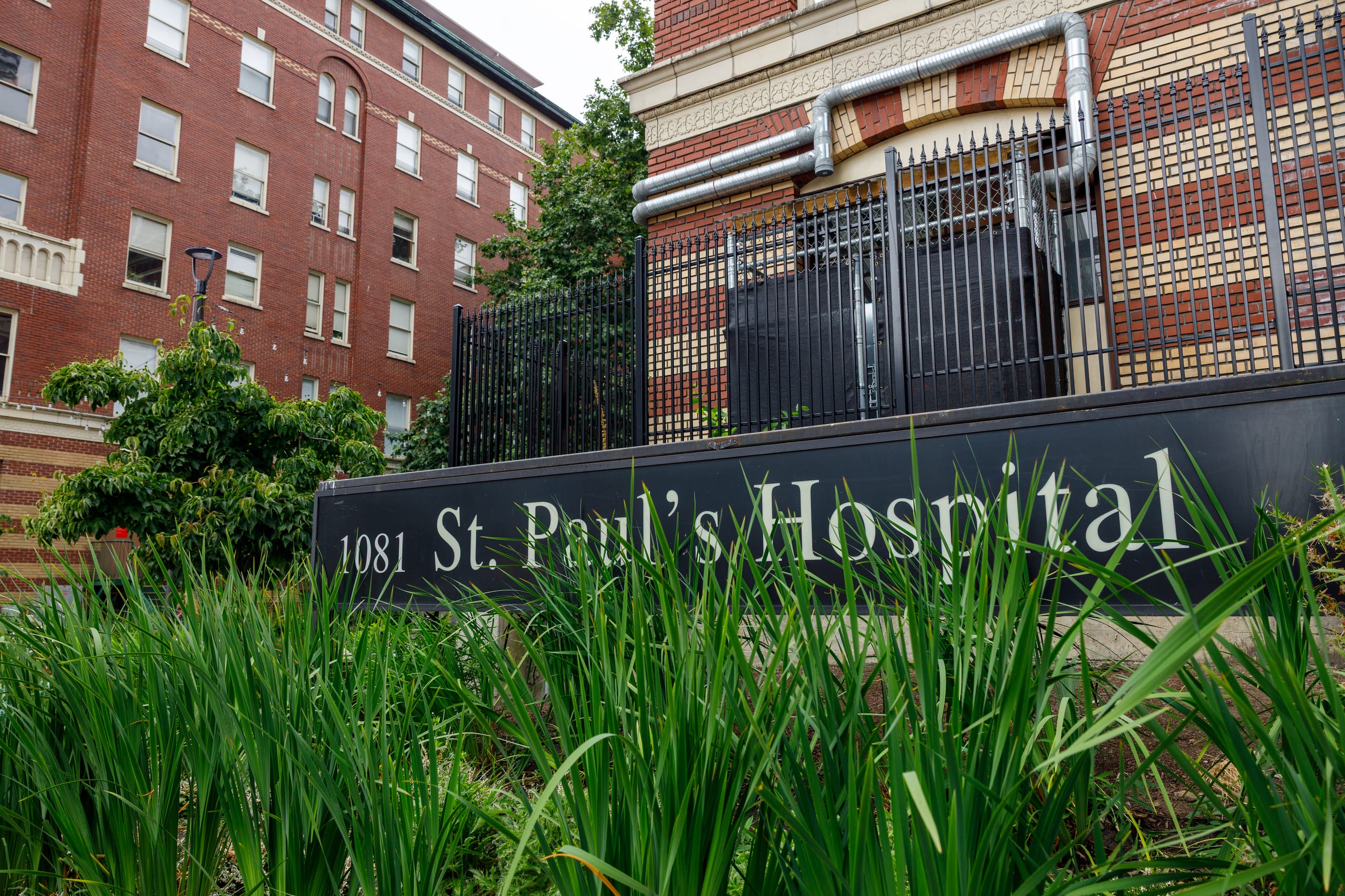
B.C. Supreme Court has dismissed a Charter challenge to the policies that let St. Paul's Hospital and other faith-based facilities refuse to provide medical assistance in dying (MAiD) on site, ruling that transferring patients elsewhere to receive it does not violate the rights of patients or doctors.
Chief Justice Ronald Skolrood released the decision on Friday, after a trial that ran over several weeks between January and April this year.
The case was brought by Gaye O'Neill, administrator of the estate of Sam O'Neill; Dr. Jyothi Jayaraman, a physician who provides MAiD; and the advocacy group Dying with Dignity Canada. They sued the Province, Vancouver Coastal Health and Providence Health Care, the Catholic organization that runs St. Paul's.
The policies under challenge
The Ministry of Health's MAiD policy allows faith-based organizations to opt out of providing assisted dying in their facilities, and Vancouver Coastal Health's policy recognizes the same option. Providence, acting on Catholic teaching, has done so. Under its policy, patients assessed and approved for MAiD at St. Paul's or another Providence facility must be moved to a non-Providence site to receive it.
The plaintiffs argued that those transfers favour Catholic beliefs over patients' rights, violate patients' freedom of conscience and religion and their right to life, liberty and security of the person, and violate the freedom of conscience of doctors who provide MAiD.
Sam O'Neill's transfer
The court heard about four patients who were transferred. Sam O'Neill was diagnosed with Stage 4B cervical cancer at 33, in April 2022, and was treated at St. Paul's. She was approved for MAiD in February 2023. When she chose to receive it on April 4, 2023, she had to be moved to a Vancouver Coastal Health space at St. John's Hospice on the UBC campus. Because of her pain, she was sedated for the transfer and never regained consciousness. Her family and friends said the process was rushed and caused her significant additional pain.
Two other patients were taken by ambulance to a site near Vancouver General Hospital. The fourth, Anna Chamberlain, was approved in January 2026, after a new space had opened next to St. Paul's. Her first scheduled time was cancelled because Providence staff weren't permitted to accompany her there to keep running her infusion pump, and her MAiD was pushed to the following afternoon while Providence and Vancouver Coastal Health worked out an arrangement.
Skolrood acknowledged that family members were "profoundly distressed" by what they saw, but said that evidence was of limited value in proving a Charter breach. All four patients received MAiD within a short time of deciding to.
Why the challenge failed
The plaintiffs leaned heavily on Carter, the 2015 Supreme Court of Canada ruling that struck down the criminal ban on assisted dying. Skolrood said this case is different: the policies don't prohibit patients from getting MAiD, aren't meant to, and the evidence didn't show that they have that effect.
On doctors, he found nothing in the policies compels a physician to act against their conscience. Doctors who work at a faith-based facility do so voluntarily and know its position. Freedom of conscience, he wrote, protects people from state coercion; it doesn't let a doctor "compel the state or other institutional actors to act in a particular manner."
On patients, he found no evidence that anyone was made to accept or observe Catholic beliefs, and said allowing faith-based organizations to operate according to their beliefs isn't state sponsorship of those beliefs. Even if the decision to seek MAiD is a matter of conscience, he wrote, that right doesn't extend to choosing the exact time and place.
On the right to security of the person, Skolrood said transfers are a routine part of health care in B.C., and that risks to individual patients are managed. Treating MAiD transfers as fundamentally different, he wrote, would amount to a right to demand MAiD at the time and place of the patient's choosing, and would "improperly insert the Court into the management of day to day healthcare operations."
He found it unnecessary to decide whether Providence, as an institution, has religious freedom rights under the Charter.
How many patients are moved
According to figures the parties put before the court, 3,000 people in B.C. died by MAiD in 2024, or 6.9 per cent of all deaths in the province. Sixty-two of them, about two per cent, were transferred to receive it. The number of transfers in B.C. has ranged from 39 to 62 a year since 2021.
Since January 2025, patients approved for MAiD at St. Paul's have been able to receive it at Shoreline, a modular building run by Vancouver Coastal Health and reached through a set of double doors off the hospital's main corridor, on land the Ministry of Health ordered Providence to turn over in 2023. The court said every patient approved for MAiD at St. Paul's since then has received it there, and a similar space is expected at or next to the new St. Paul's Hospital, which is under construction.
The action was dismissed. The plaintiffs can appeal to the B.C. Court of Appeal.
Source: Supreme Court of British Columbia, O'Neill v British Columbia (Minister of Health), 2026 BCSC 2316, reasons for judgment of Chief Justice Skolrood, Nov. 27, 2026 (full decision).