Construction begins 1.5 km underground on DUNE, the giant neutrino experiment built by Fermilab and CERN

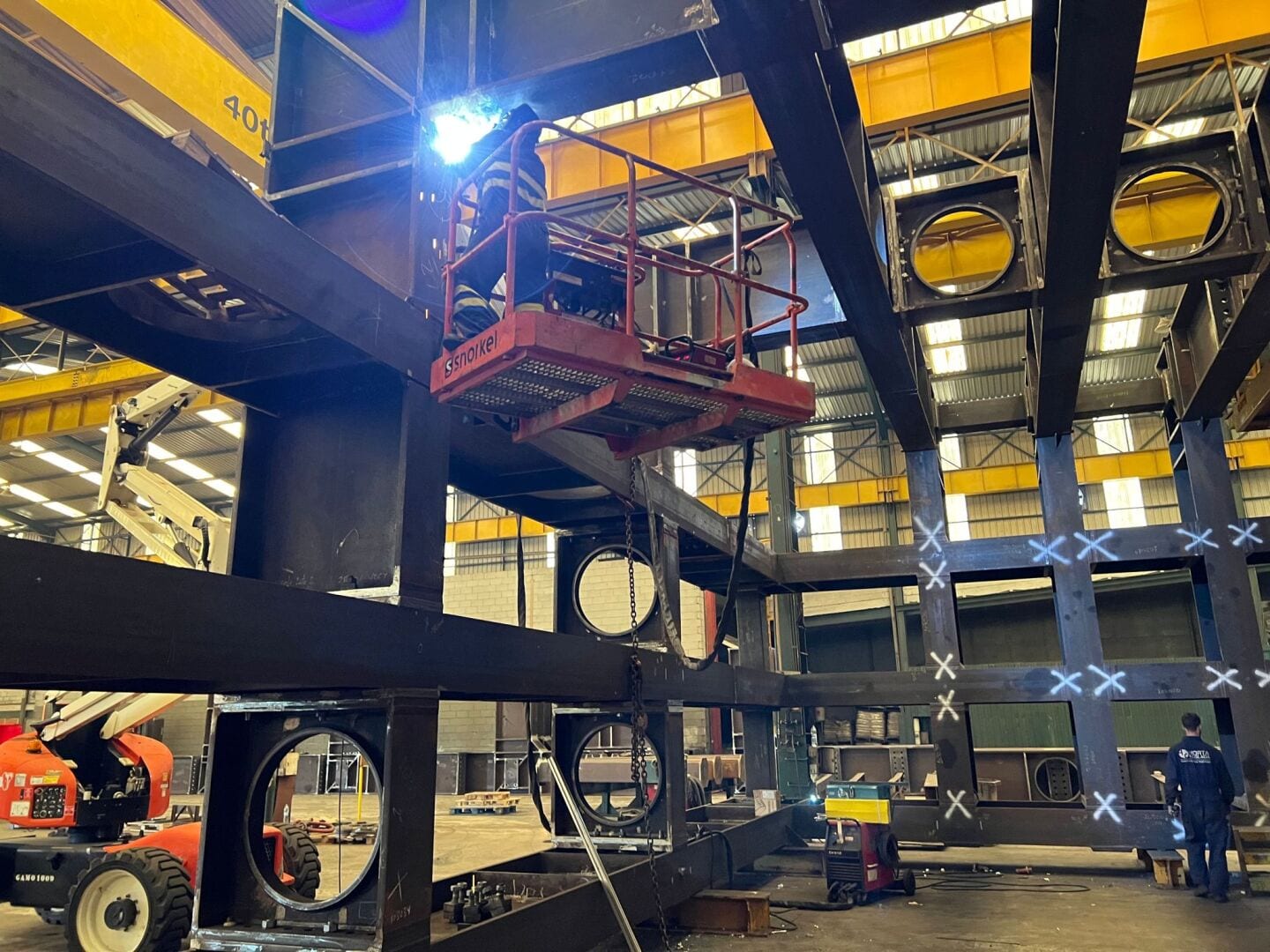
Nearly 1.5 kilometres beneath South Dakota, crews have started assembling the giant steel containers that will hold the heart of the Deep Underground Neutrino Experiment (DUNE), one of the largest physics projects under way anywhere.
Teams from Fermilab, the U.S. Department of Energy laboratory that hosts DUNE, and CERN, the European particle physics laboratory, are working with the Sanford Underground Research Facility (SURF) in Lead, S.D. They are building the cryostats, insulated vessels that will each hold about 17,000 tonnes of liquid argon chilled to roughly −185 C.
Bigger than a 747
Each of the two cryostats will measure 66 metres long, 19 metres wide and 18 metres high. That makes each one longer than a Boeing 747.
Their outer frames are made of red steel beams, 2,600 in all, lowered one at a time from the surface down the mine shaft to the assembly area. The more than 6,200 tonnes of steel are an in-kind contribution from CERN, which also leads the design, construction planning, logistics and installation of the cryostats, working with a Minnesota structural steel contractor.
Assembly has begun in the facility's South Cavern. SURF crews have also started lowering steel for the second cryostat into the North Cavern, where assembly is expected to start next year.
It is the first time CERN has contributed on this scale to an experiment outside Europe. The lab developed the cryostat design and built ProtoDUNE, a prototype of the two detector technologies DUNE will use, at its Neutrino Platform facility.
"Collaboration is in CERN's DNA," said CERN Director-General Mark Thomson. "After years of planning and careful coordination, I am thrilled to see that we are ready to start installation."
A 1,300-kilometre beam
Neutrinos are tiny, nearly massless particles that pass through ordinary matter almost without a trace, which makes them hard to study. When DUNE is running, Fermilab, outside Chicago, will fire a beam of neutrinos 1,300 kilometres straight through the Earth to the liquid-argon detectors in South Dakota. A second detector near the source at Fermilab will measure the beam before it sets off.
Together, the two sites make up the Long-Baseline Neutrino Facility. The detectors will also watch for neutrinos arriving from the Sun and from deep space.
"DUNE is Fermilab's top priority," said Fermilab director Norbert Holtkamp. Beyond deepening understanding of the universe, he said, the experiment could "open the door to new technological advances."
Timeline
The underground space is scheduled to be finished by 2029 and the detectors by 2030, when a team of about 1,800 researchers is due to begin taking data. The neutrino beam, powered by Fermilab's PIP-II accelerator upgrade, is expected to reach South Dakota by 2031. The experiment is planned to run into the late 2040s.
The DUNE collaboration has more than 1,500 researchers. Co-spokesperson Sowjanya Gollapinni called the start of construction "an incredible milestone" that reflects the partnership between CERN, Fermilab and SURF.
SURF director Mike Headley said the project is also bringing high-paying jobs to South Dakota's Black Hills.
Source: CERN, Fermilab and Sanford Underground Research Facility, "Construction begins on massive underground neutrino experiment designed to unlock the secrets of the Universe," Nov. 10, 2026.