



Category Archives: Science
Researchers used brain MRIs to build an AI that thinks like a human brain — and it is more resilient than standard deep learning

A team of researchers in Beijing has built an artificial neural network modelled directly on the primate brain’s visual system — and the result is an AI that makes decisions more like a human and holds up far better under
New wearable sweat sensor uses pH to accurately track blood sugar during exercise

Researchers have developed a wearable sweat sensor that can continuously track blood glucose levels during exercise — a breakthrough that could transform how people with diabetes manage their condition while staying active. The device, described in a study published today
BC’s clocks are staying put. Are your computers?

By Rohana Rezel British Columbia has sprung forward for the last time. On March 2, 2026, the provincial government confirmed that the twice-yearly clock change is over. The final spring-forward happened on March 8, and when November 1 arrives, BC
How Canadian media covers renoviction — and what it misses

A new study published in Housing Studies has examined how Canada’s mainstream print media frames renovictions — the practice of evicting tenants under the guise of renovation — finding that coverage has grown alongside the housing crisis but often stops
Even Tiny Amounts of Altruism Can Stop Epidemics, Game Theory Study Finds

A new mathematical study has found that people don’t need to be saints to justify staying home when they’re sick. In fact, caring about others even a tiny amount — valuing your own life as roughly equivalent to 100,000 strangers
Rigid protocols can hinder firefighting teams during crises, study finds

When emergencies take unexpected turns, the teams that communicate most explicitly tend to perform best — even if rigid protocols previously guided their actions, new research shows. A study published in Organization Science examined how firefighting teams adapt when disruptive
Bilingual brains use one shared meaning system for both languages, but each language reshapes it, study finds
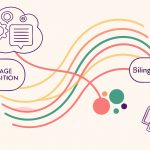
Bilingual people use largely the same brain system to understand meaning in both their languages, but each language subtly reshapes how that system processes different categories of words, according to new research from UC Berkeley. The study, published Monday in
Electronic nose detects ovarian cancer in blood with 97% accuracy, 100% at patient level
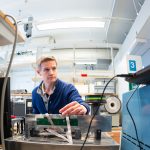
A device that essentially “smells” cancer in a drop of blood has demonstrated near-perfect accuracy in detecting ovarian cancer, according to new research published in Advanced Intelligent Systems. The electronic nose — a 32-sensor array that detects volatile organic compounds
Difficult people in your social circle may be accelerating your biological aging, study finds

People who make your life difficult may be doing more than ruining your day — they could be making you age faster at the molecular level. A new study from researchers at New York University, Utah State University, the University
Physicists show electric charges can be accelerated without producing radiation

One of the oldest rules in physics — that accelerating an electric charge always produces radiation — turns out to have an exception. A team of physicists has shown that in quantum mechanics, it is possible to accelerate a charged
